
Tim Bildhauser
2021-present
International comics specialist, Warehouse Comics, Cards & Games.
View advisor profile »Quick Links: Advisors · CPV Introduction / Primer · Using the Guide
Meet the team of collaborators responsible for v9 of the CPV Price Guide. Click any advisor image or name to visit that advisor’s profile page for their market reports & articles.
International comics specialist, Warehouse Comics, Cards & Games.
View advisor profile »
Overstreet Advisor, CGCData.com administrator, writer for GPAnalysis and SlabData.com.
View advisor profile »
Senior Overstreet Advisor, comic book historian, discoverer of Marvel 30 and 35 cent variants, and proprietor of jonmcclurescomics.com
View advisor profile »
Toronto-based Canadian Price Variant specialist.
View advisor profile »

Project organizer; author of the Rare Comics blog
View advisor profile »
Overstreet Advisor and President of mycomicshop.com
View advisor profile »
Senior Overstreet Advisor since guide #2 in 1972, and proprietor of dougcomicworld.com
View advisor profile »
Cover price variant collector and historian. (Contact by email)
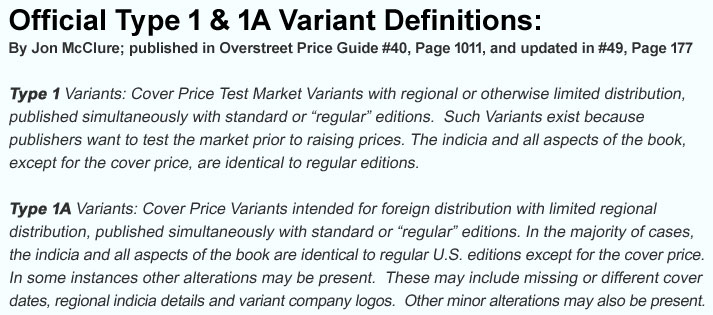
View advisor profile »Type 1A cover price variants (full official definition below) are 1st print original variants, published simultaneously with the regular editions. Across our guide spanning the 1970's, 1980's, and 1990's, almost all CPVs — 99.9% of our coverage universe — were exclusive to newsstands and carry bar codes (UPC codes) on the covers.
First, let us discuss Marvel and D.C. as the two heavyweight publishers of the era, and responsible for the most popular guide titles that collectors browse.
Entering the 1980's, Marvel and D.C. each sold comics through two distinct distribution channels: “Direct Edition” copies were directly sold to comic shops on a non-returnable (but discounted) basis; “Newsstand” copies meanwhile were distributed to newsstands across North America, and unsold copies could be returned. In the beginning of the 1980's, all of North America got the same identical newsstand copies.
But starting in October of 1982, due to currency fluctuation, these publishers could no longer afford to charge the same 60¢ price on newsstands in population centers like Toronto, Vancouver, and Montreal — i.e. places where buyers would be paying in Canadian currency. For this reason, both publishers started to demand 75 cents from those newsstand customers north of the border. But instead of placing both US and Canadian prices on newsstand copies as they eventually did, from 10/1982, out to 8/1986 for Marvel and out to 9/1988 for D.C., these publishers produced two distinct batches of newsstand copies: a higher cover price batch and a lower cover price batch.
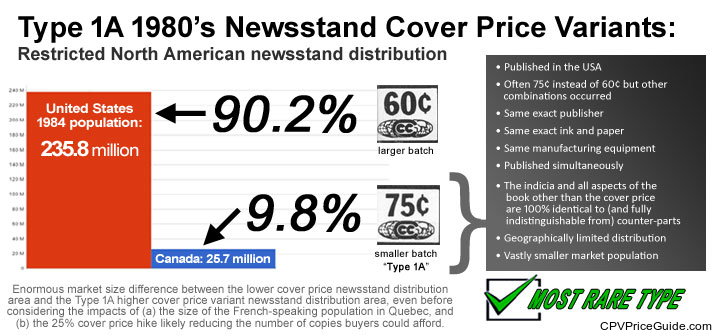
[Click here for a detailed explanation of these graphics, or Click here for a video walkthrough  ]
]
Each batch was produced simultaneously with the other copies on the same manufacturing equipment, so all are 1st print copies (each batch involving only a change of the black/key plate), but the number of copies created for each batch was different, with each batch sized to fit the corresponding market: the Direct Edition batch size was informed by comic shop order levels, and each of the two Newsstand batch sizes were informed by the size of the target market and newsstand sales trends. The smaller batch of higher cover price newsstand copies — the copies today known as “Type 1A cover price variants” were therefore sold in vastly smaller numbers.
But equally important is that newsstand comics were purchased mostly by readers, whereas direct edition comics were mostly purchased by collectors, who then preserved their condition. Direct editions of this era were so well preserved in fact, that the consensus among the Overstreet advisors on our collaboration team is that direct editions represent roughly 80% of the total surviving copies of 1980's comic books. That leaves roughly 20% as newsstand copies; and applying the approximate 90:10 market size difference by population size shown above, we reach an estimate of roughly 18% of surviving copies being regular newsstand copies and roughly 2% being the Type 1A price variant newsstand copies, as we illustrate below (note: the tilde symbol ‘~’ means ‘approximately’ as these are estimates):
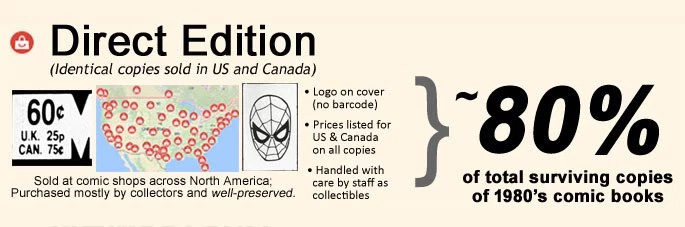
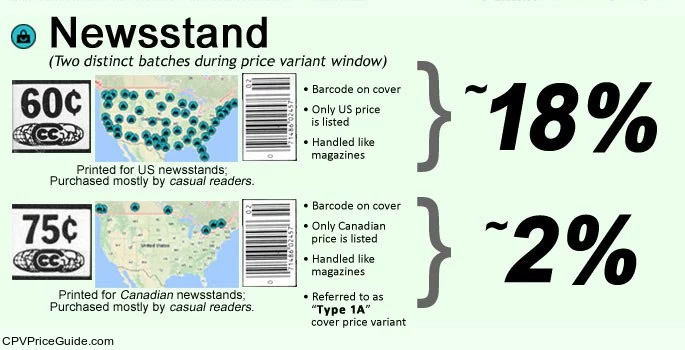
[Click here for a detailed explanation of these graphics, or Click here for a video walkthrough ]
It is important to note, however, that each individual issue will have its own survivorship characteristics depending on factors including the overall share of newsstand sales (versus direct edition) at the time of publication (with newsstand distribution in 1982 considerably stronger than in 1988), and whether comic shops ordered enough direct edition copies of the issue to satiate collector demand (if collectors could not get their fill at their local comic shops for a particular issue, they may have turned to their local newsstands to collect copies of that issue, driving a higher than average CPV survivorship rate).
Certain issues, especially among DC titles like Batman and Crisis on Infinite Earths see issues with CGC census rarity of under 2% for the CPV, while some of the more noteworthy Marvel “event” issues have CGC census rarity closer to 6% for the CPV. Greg Holland has reported that across all issues where CGC has a CPV on record, census rarity has been around 2.8% for Marvel CPVs, and 3.1% for DC CPVs.
It is also important to consider that the marketplace for CGC-graded CPVs is focused on the major keys, representing a small subset of the overall universe of CPVs that actually exist. Many of the major key issues were published earlier in the window; among the top keys in our guide, the median publication year is 1984. And for Marvel (which represents a greater share of sales in the comic book marketplace versus DC) the top Marvel keys have a median publication year of 1983 — in other words, skewed more towards the beginning of the price variant window.
Given these factors, a separate question that can be studied is what share of actual marketplace sales do CPVs represent, among the most popular issues where CPVs exist? In Greg Holland's studies of GPAnalysis data, the percentage has been around 3% across all grades, and about 2% among 9.8 copies.

[Click here for Greg's article presenting GPA data in greater detail]
Thanks to the research efforts of Salvatore Miceli, our guide's coverage universe now includes Archie, Gladstone, and Harvey as additional publishers. Each of these publishers has varying dates during which price variants were published, and there are also different distribution circumstances to keep in mind versus over at Marvel/DC: for example with Archie, direct editions were generally only introduced much later (with certain titles only getting their first direct editions way out in September of 1988), with early 1980's keys like Archie's Girls Betty and Veronica #320 (1st Cheryl Blossom Appearance) having had only newsstand distribution. Archie kept publishing their price variants well past the end of the '80s and into the '90s (Gladstone and Harvey also published variants into the 90's) and even “Phase III” CPVs in 2007-2009. Read more detailed introductions at the following links about the variants from Archie, Gladstone, Harvey (see also: Beetlejuice, Beetlejuice, Beetlejuice), & Modern. In recent years thanks to Doug Sulipa we have both a Harvey CPV Price Guide and a Whitman 1984 CPV Price Guide to share with you. Also in case you missed it, please see the Market Reports & Articles section, for various articles covering pre-1980's and post-1990's Canadian Price Variants.
↑ BACK TO TOP CPV Articles & Market ReportsA subset of the team of price guide contributors have independently submitted advice on variant values for top key comic books. The median of those advised values collected for each issue — i.e. the middle ground number at which exactly half of advisors who participated gave an equal or lower value opinion and half of advisors gave an equal or higher opinion — were used to compile a Top 100.
By comparing these median advisor values for each issue against the “base Direct Edition value” for those same issues, a variant premium was discovered which helped inform the rest of the guide, as well as the extensive in-house sales of CPVs by key members of the advisory team. The base Direct Edition values were determined by reviewing opinions from up to three different popular comic book price guides.
This guide is presented on a best-efforts basis, but none of the included information is guaranteed to be free of human error; and due to the sheer volume of issues included in the guide (over five thousand), it was not possible to individually verify all information issue by issue or to confirm the existence of every variant by observing a photograph of each variant proving its existence, but we have included Marvel & DC variant pictures with 99% picture coverage. For those issues where we have not verified the existence of the variant with pictures, there is reason to believe the variants should exist; but is it also possible that certain included issues were actually direct edition exclusives lacking newsstand distribution, or had newsstand distribution in the US but not Canada. Therefore you should use this guide only as one tool among your comics research tool-belt, and you should verify information with other sources before acting. Expected variant cover price, for example, can be error-checked by referencing a direct edition copy and looking up the small-print Canadian price tag — that small-print price would then be the expected cover price used for the smaller newsstand batch (although we have found exceptions, such as Thundercats #1).
Information columns presented in the main guide Title pages are: Issue (and date), Direct Edition value, the expected cover price found on variant newsstand copies, and finally our guided Variant values (all guided values presented are for “raw” copies; all guided values are presented in US Dollars). The final column is used to indicate the recent census CPV percentage at CGC, as of 2026. A further CGC Snapshot table presents further census history and details, with links to visit the live CGC Census pages for the most up-to-date figures.
At the bottom of each row, Advisor Notes may appear for a given issue for noteworthy items such as 1st appearances; Advisor notes are displayed in green; CGC label notes (when key comments notes were found) are displayed in blue. In the full guide pages for each title, rows are highlighted in yellow by noteworthy value above a threshold. Direct edition value columns are highlighted with a pink circle in cases where noteworthy value disagreement among price guides was spotted and flagged.
Expand any guide row by clicking/tapping at the bottom of the row; this will bring up expanded notes and details, along with our new “My Collection” and “Watchlist” tools, which can be used to add the issue to either your watchlist or collection. Click any cover image to reach the individual issue page with greater details, large format cover image, and historical charts of guide values over time.
Reach “My Collection” and “Watchlist” at any time from the main menu, where you can view issues previously added, or add new ones. Note that the collection data you enter is stored in your local browser on your own device only. Buttons are provided to download .csv format backups, whenever you want to back up your data, or transfer to another browser or device.
CGC census information is presented throughout the guide, comparing the census counts since the v8 guide, for both the main/regular census entry and the variant census entry. The census counts are drawn from one point in time, during the early 2026 construction of the v9 guide, and the provided CGC census links should be used to look up the most up-to-date figures.
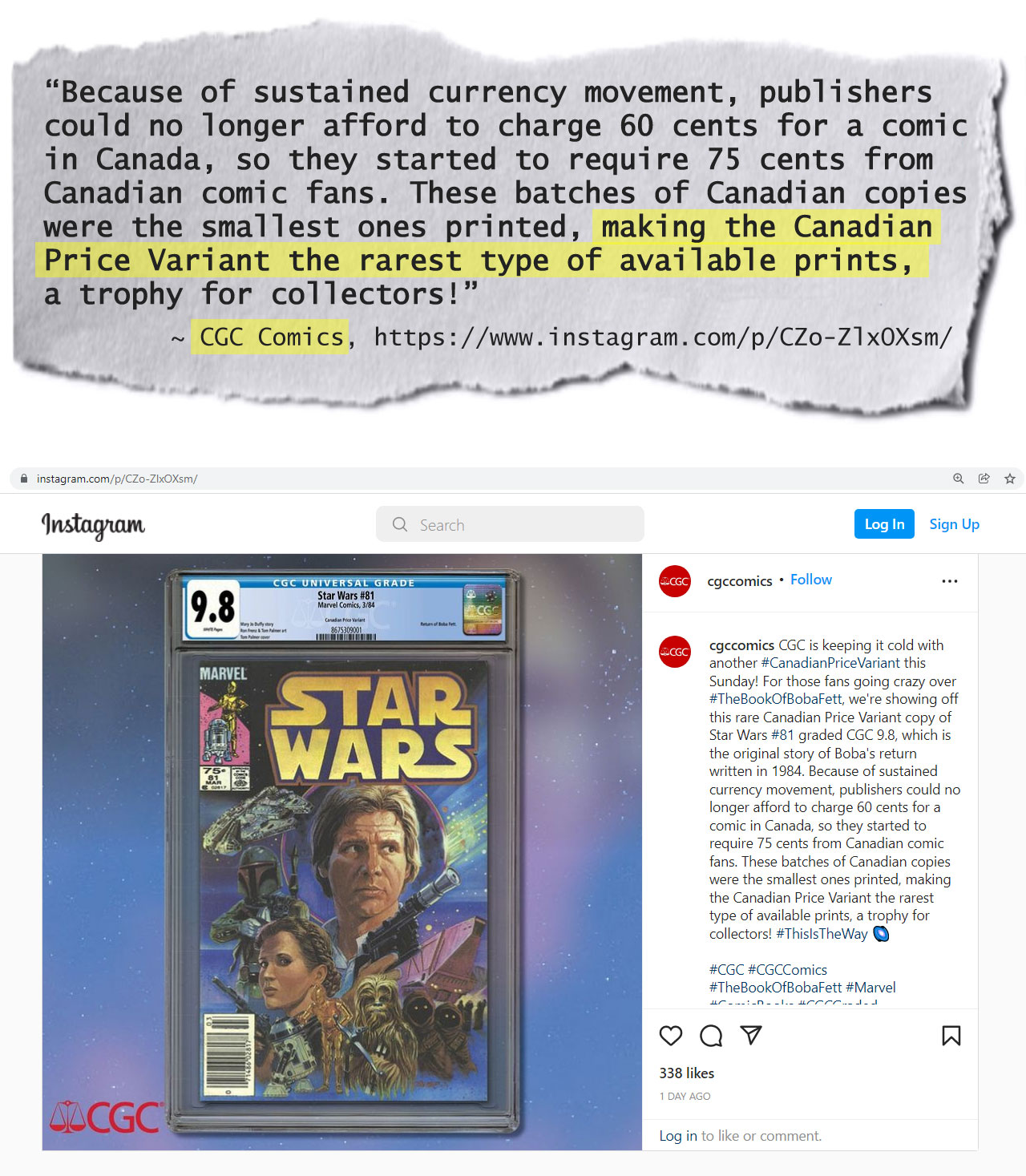
We have also introduced a page presenting the top CGC census grades for top CPVs. Note that as of May 2019, CGC now catalogs the variants on their census under the name “Canadian Price Variant” while typically pointing out the variant cover price on the right-hand side of the label — this replaces their prior labeling of "Canadian Edition" (all census data was ported over by CGC from the old terminology to the new terminology).
The most common terminology you will find in the marketplace for these variants are “Cover Price Variants”, “CPVs” (CPV being an abbreviation for Cover Price Variant or for Canadian Price Variant depending on context), “Type 1A Variants”, “Canadian Price Variants”, “Canadian Newsstand Editions”, and older slabs prior to October 2018 for CBCS and prior to May 2019 for CGC will show the variant name as “Canadian Edition.”
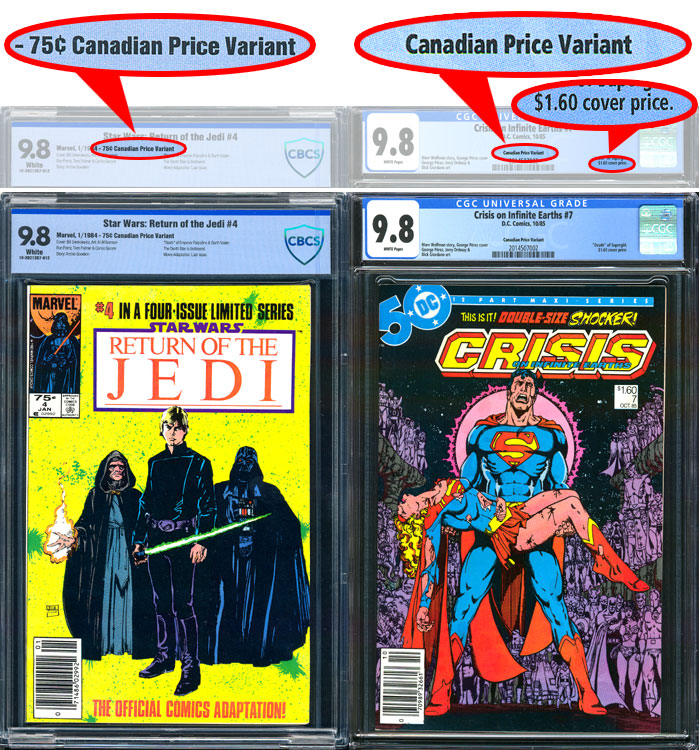
Example CBCS and CGC labels (current labeling treatment as of time of guide publication):